Product Overview
These are loose white freshwater pearls in the smallest diameter we keep: 3~3.5 mm, perfectly round, graded AAAAA with excellent luster and a clean surface. Each pearl weighs about 0.055 g and a full lot weighs 0.39 kg, so you are buying material by weight rather than a finished piece of jewellery.
Pearls this small really shine in detail. They sit shoulder to shoulder in a pavé row, line the edge of a setting, fill an embroidered panel or run in one fine strand — the kind of white pearl necklace that reads as a thread of light against the skin rather than as a statement bead. Our customers buy them for exactly that: a design that needs many identical round beads instead of a few large ones.
Buying loose also leaves the stringing, the clasp and the metal in your hands. A freshwater pearl necklace built on this size can be as delicate or as dense as the drawing calls for, and if a bead is lost later the replacement comes from the same grade rather than from whatever a ready-made piece happens to have on hand. The pearls arrive loose, so nothing in the parcel is tied to a chain or fitting you did not ask for.
Pearl Quality & Grading
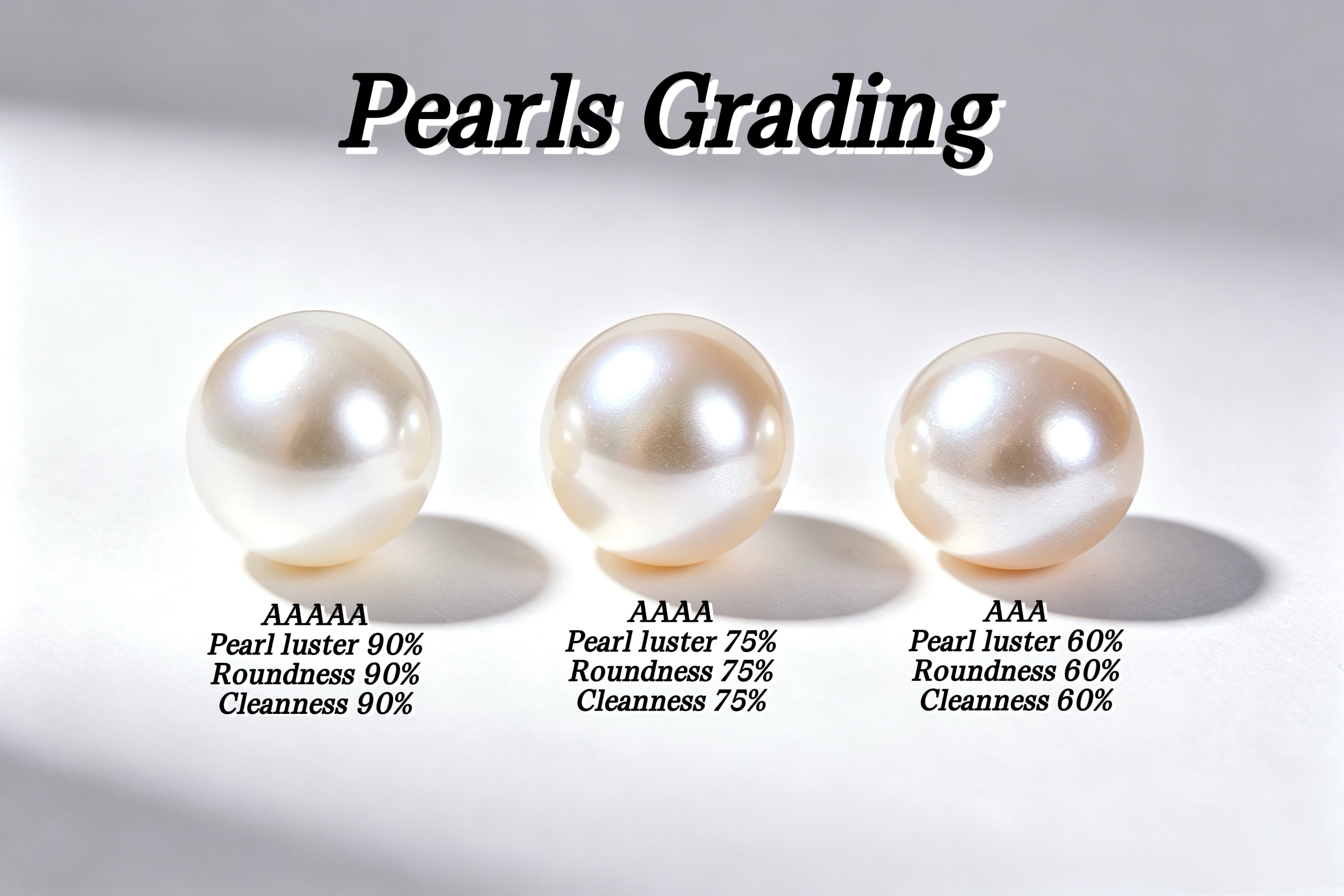
- Grade AAAAA. The top of the five grades we use. On our grading chart, AAAAA sits around 90% for luster, roundness and cleanness, against roughly 75% at AAAA and 60% at AAA — the quickest way to read the letters when you cannot hold the pearls in your hand.
- Excellent luster. The surface returns a tight, bright reflection rather than a milky haze. In a row of small beads that is what keeps a strand looking alive under shop lighting and in photographs.
- Clean blemishes. Graded Clean, so the surface carries none of the spots, pits or faint rings that show up disproportionately on small pearls, where one flaw covers a large share of the bead.
- Perfectly-round shape. Roundness matters more at this size than at 12 mm. Small pearls string shoulder to shoulder, and a single off-round bead breaks the line, so the lot is sorted to roll and sit evenly.
- White with a neutral cast. The tone holds white under daylight rather than drifting cream, which is why the lot suits a white pearl necklace that has to sit beside silver or diamonds without pulling yellow. The faint pink-green overtone in the photographs is the pearl's own.
- Sorted, not averaged. The whole batch is graded to one standard, so any handful you pull should show the same luster and the same clean surface as the bead on top.
- Cultured pearl, not an imitation. These are grown freshwater pearls, not shell, glass or coated beads. If you are matching against a real pearl necklace already in a customer's hands, grade, tone and round shape are what let a replacement bead disappear into the strand.
Specifications
| Specification | Detail |
|---|
| Pearl type | Freshwater pearl |
| Colour | White |
| Grade | AAAAA |
| Size | 3~3.5 mm |
| Shape | Perfectly-round |
| Luster | Excellent |
| Blemishes | Clean |
| Average weight | 0.055 g per pearl |
| Lot weight | 0.39 kg |
| Supplied as | Loose pearls |
| Temporary strand length | Approx. 39.5 cm |
| Price basis | Quoted in USD; accessories not included |
Quantity & Strand Planning
Buying loose means doing a little arithmetic first. Each pearl averages 0.055 g and a full lot weighs 0.39 kg — roughly 7,000 pearls in one batch, enough to carry a small production run rather than a single commission. If you are building a freshwater pearl necklace from scratch, that is the figure to plan against rather than the piece count of one finished strand.
Our loose strands run about 39.5 cm. On a finished piece the total length shifts with the clasp and any other fittings you add, so quote your own finished length rather than the strand measurement. A layered pearl necklace multiplies the material: every extra row is another full count of pearls, so two rows roughly double the weight you need and three rows triple it.
A pearl choker necklace sits higher on the neck and takes noticeably fewer pearls than a matinee or an opera length, so the same weight covers a very different number of finished pieces depending on the design. Sketch the piece, count how many pearls your own stringing uses per centimetre, and work back to grams before you place the order.
Design Applications
- Micro-pavé and fine settings. The beads sit shoulder to shoulder in a narrow channel or around a small stone, so a design can carry a continuous line of lustre without the weight larger pearls bring.
- Delicate single strands. Strung on fine silk or a light wire, a dainty pearl necklace at this size reads almost like a thread of light on the skin, and it layers under a collar without added weight.
- Bridal and occasion detail. Small pearls work into hairpins, bodice and veil embroidery, bouquet wraps and cuff details. On the neck they give a small pearl necklace the close, even look formal styling calls for, in places where a 10 mm bead would be too heavy to place.
- Embroidery and beadwork. They sew down onto tulle, lace, satin and even denim, and their round shape saves orientation work: every bead presents the same profile.
- Cluster studs and drops. Three or four of these clustered on a post build the look of a larger stud while keeping the ear light, a common request for bridal parties and younger customers.
- Repair and re-stringing stock. A retailer who keeps a small jar of these on the bench can replace a lost bead in a women's pearl necklace without sending the piece away, which is often worth more than the pearls themselves.
- Graduated and tapered strands. Use the small size at the clasp ends and step up through 6.5~7 mm and 7.5~8 mm toward the centre for a classic graduated strand.
Colour Consistency
At 3 mm, tone differences surface faster than they do on a 12 mm pearl. The eye reads a row of small beads as one continuous line, so the bead half a shade warmer than its neighbours becomes the thing you notice first — more than any single pearl's shape. A white pearl necklace built from this size lives or dies on sorting rather than on the grade alone.
We sort white lots before packing, but a bag of loose pearls will still show a natural spread: the white runs from a cool, bright white to a slightly warmer ivory, and the overtone shifts from faint pink to faint green bead to bead. That spread is normal in untreated freshwater pearls, and it is also what stops a finished strand from looking flat and synthetic.
Keep one lot together for one piece. If you are mixing two lots, tip both onto a white cloth in daylight — not under warm shop light, which flatters everything — and sort into three piles: cooler, neutral, warmer. Use each pile for a separate strand or a separate part of the design rather than alternating beads at random.
For a women's pearl necklace programme replenished season after season, hold back a small reference set from each lot so the next delivery can be matched against actual pearls instead of a photograph. And because a pearl choker necklace sits right at the throat, close to the face and under the most light, reserve the most even tone for the beads that will sit at the front.
Handling & Care
- Work over a soft cloth. A 3 mm pearl that rolls off the bench is hard to find and easy to crush; a folded cloth under the tray catches most of them.
- Wipe, don't wash. After handling, wipe the pearls with a soft, slightly damp cloth and let them dry in the air. Never soak them, and keep ultrasonic cleaners and steam away from pearls.
- Keep chemicals off them. Perfume, hairspray, cosmetics, chlorine and household cleaners all dull the nacre. On a finished piece, put the pearls on last when dressing and take them off first at night.
- Store them apart from metal. A soft pouch or a compartmented tray keeps beads from rubbing against chains and findings, which scratch a pearl surface long before wear does.
- Hold unused stock cool and dark. Beads that will not be strung for a while are better in a closed container away from radiators and direct sun than in an open tray on a windowsill.
- Check finished pieces periodically. Silk stretches with wear, and a freshwater pearl necklace that is worn often should be looked over for loose knots and re-strung before the thread shows.
- Give a finished strand its own space. A real pearl necklace kept loose in a jewellery box among chains picks up scratches faster than it ever loses its luster.
Findings & Size Pairing
- Thread and wire. Small pearls need a finer gauge than a 7 mm bead: heavy wire crowds the drill hole and stiffens the strand. Fine silk gives the softest drape for a dainty pearl necklace, while a light coated wire holds a shape better when the piece has to sit flat.
- Settings. A cup or prong setting sized to the bead, or a peg setting for studs, holds a 3 mm pearl securely; anything proportioned for a 6 mm bead will swallow it.
- Clasps. Proportion matters. A compact box or hook clasp keeps the scale of a fine piece, and on a pearl choker necklace a low-profile clasp sits flat at the nape instead of riding up.
- Metal choice. 925 silver keeps a small-bead piece light and at an easy price point; 18k gold lifts it into gift territory and adds a little weight at the clasp, where a fine strand needs it most.
- Mixing scales. The same white freshwater grade runs on up through 6.5~7 mm and 7.5~8 mm, which makes a graduated strand straightforward. For a layered pearl necklace the contrast does the work: one fine 3 mm row close to the skin, a second row at 6.5~7 mm above it.
- Matching into pairs. For earrings, tip the pearls onto a white cloth and pair them by eye on diameter and tone before setting. Pairs come together far faster from one lot than from two.
Ordering & Delivery
- Set the order up front. Tell us the size you need, roughly how many pearls the run takes, and whether it is a stock line or a custom job. Our minimum spend is USD 500.
- Custom work runs on confirmation. Send a reference design or an idea and our team will source suitable materials and make to it, checking the details with you several times along the way — photographs and video included — before anything is packed.
- Payment. We accept telegraphic transfer (T/T), Alipay, WeChat Pay, Mastercard and Visa. If you have placed an order by mistake, tell us within 24 hours and we can cancel it before it moves into production.
- Dispatch. Orders are dispatched within 3–5 business days. Custom work takes longer, so ask us to confirm the schedule once the brief is agreed.
- Delivery. Parcels travel by FedEx, DHL or SF Express and typically arrive in 5–7 days, though customs clearance in your country can extend that. Every order ships from Hong Kong.
- Duties and taxes. Prices are quoted in USD and do not include customs duties or import taxes, which are the customer's responsibility. Accessories shown in the photographs are not part of the order.
- Larger quantity pricing. We offer preferential pricing on larger quantities — send the size and the volume and we will quote for it.
- Final sale. All sales are final and we do not accept returns or exchanges. That is precisely what the confirmation steps above are for: settle grade, tone and quantity before the parcel leaves Hong Kong.
Drilling & Hole Options
- The pearls leave us as loose beads, so the drill hole is a specification you set rather than something already cut into the stock. Tell us what the piece needs when you place the order and we confirm it against your quantity before anything is packed.
- Give us the diameter. A 3~3.5 mm bead takes a far finer hole than a 6.5~7 mm or 7.5~8 mm pearl, so quote the wire, pin or thread you intend to string on — in millimetres where you can — and we will confirm which drill size is workable for the run.
- Choose full drill or half drill. A full drill runs clean through the bead for stringing, pavé rows and embroidery; a half drill leaves a blind hole for a peg, post or cup setting. Say which one the design needs, because the two are not interchangeable once the beads are cut.
- Position matters at this size. There is very little pearl around a 3 mm hole, so a hole that sits off-centre or leaves a rough edge shows up in a fine row far more than it would on a 12 mm bead. Where the hole sits is as important as how wide it is.
- Keep a run consistent. On a cluster, a pavé row or a pair of earrings, the beads need the same hole placement so they line up and hang evenly. Have the whole piece drilled in one order rather than topping up mid-production.
- Confirm before packing. Once your drill specification is agreed, we check it against the order, share detailed photographs and video, and make a final confirmation with you before the parcel is sealed — which is why the hole detail belongs in your first message, not after the invoice.
- Sketch it if you are unsure. Send a drawing of the setting or describe how the bead will be held, and we will tell you what is practical at 3~3.5 mm for the quantity you need.
Scale & Supply Capability
KT JEWELLERY has been based in Hong Kong since 2006, with a team of 106 looking after selection, quality control and dispatch under one roof. Our in-stock selection runs across sizes, colours and grades, so most orders leave without a long wait. Custom work is welcome: share a reference design or an idea and we source suitable materials, make to it, and confirm every detail with you — photos included — before dispatch. Every piece passes through our own quality control, and we are a regular presence at the Hong Kong Jewellery Show.
FAQ
Q1. Are these pearls natural white or dyed?
Natural white. We keep dyed tones in separate lines and label them as dye colour, so there is no colour treatment here to fade or to re-match on a second order. The white carries a faint pink-green overtone, which is the pearl's own.
Q2. Are the pearls drilled, and can I request a specific hole size?
The pearls are supplied as loose beads. If the design needs a drill hole — full-drill, half-drill, or a particular diameter and position — tell us before the order is packed and we will confirm what is possible for your quantity.
Q3. How do these compare with the 6.5~7 mm white pearls in the same grade?
Same grade, same excellent luster, same clean surface; the difference is scale and what each size is good at. At 3~3.5 mm the pearls disappear into detail and into fine rows, and this is the size that makes a layered pearl necklace work — one fine row close to the skin, a heavier row above it. The 6.5~7 mm pearls carry a stud, a pendant or a single-strand piece on their own.
Q4. Will 3~3.5 mm read too small in a finished piece?
Not in a row. A single 3 mm pearl alone is a whisper, but set twenty or a hundred of them together and the piece reads as fine jewellery rather than as something undersized. This is the classic scale for a dainty pearl necklace, for pavé rows and for anything meant to sit close and delicate. Where it will feel small is as a lone centrepiece, which is a job for the larger sizes.
Q5. How can I keep the pearls shining?
Wipe them with a soft, slightly damp cloth after handling and dry them in the air — no soaking, no ultrasonic, no steam. Keep perfume, hairspray and household cleaners off them, and store them away from metal so nothing rubs the surface. A real pearl necklace, or a finished bracelet that is worn often, should be checked for stretched silk and re-strung before the thread shows.
Q6. What should I check when the pearls arrive?
Open the bag over a white cloth in daylight rather than under warm shop light, and check three things: that the diameters sit inside the 3~3.5 mm band, that the luster is even from bead to bead, and that the tone matches what you were expecting. If the pearls are going into a women's pearl necklace that is already in production, lay a few new ones beside the old ones before you string — that is the comparison that matters.