Product Overview
These are loose white freshwater pearls in the 6.5–7 mm range: perfectly round, graded AAAAA, with excellent luster and clean surfaces. They arrive unstrung and without fittings, so the length, the clasp and the setting stay your decision. It is the size most workshops reach for when a white pearl necklace has to look even from across a display table without turning into a statement piece.
6.5–7 mm sits in the middle of the range we carry, above the very small 3–3.5 mm pearls used for fine work and below the 7.5–8 mm and larger sizes that read as a statement on the neck. A freshwater pearl necklace built from this grade reads as jewellery first and as stock second: bright, creamy and light enough to wear through a working day.
Most of this size goes to workshops, independent retailers and designers who need repeatable stock rather than one-off pieces — a jeweller building a run of studs, a retailer restocking a plain strand, a studio sampling a bridal set. The lot is rated 4.6 out of 5 across 62 reviews, and it matters because a genuine pearl necklace is only as consistent as the pearls behind it.
Lots are packed in clear containers so you can check the pearls without opening them. Work over a tray: round pearls roll, and a 6.5 mm pearl is small enough to vanish into a carpet. Pearls set aside for a pearl necklace set go back into the same container, which keeps a busy bench from turning into a sorting job at the end of the day.
Specifications
| Pearl | Freshwater Pearl |
| Pearl color | White |
| Pearl grade | AAAAA |
| Pearl size | 6.5~7mm |
| Pearl luster | Excellent |
| Pearl blemishes | Clean |
| Pearl shape | Perfectly-round |
| Length | 6.5~7mm |
| Weight | 3.27kg (0.42g/pc) |
| Supply format | Loose pearls, unstrung |
| Fittings | Not included |
| Price basis | Quoted in US dollars per lot |
Pearl Grade & Quality
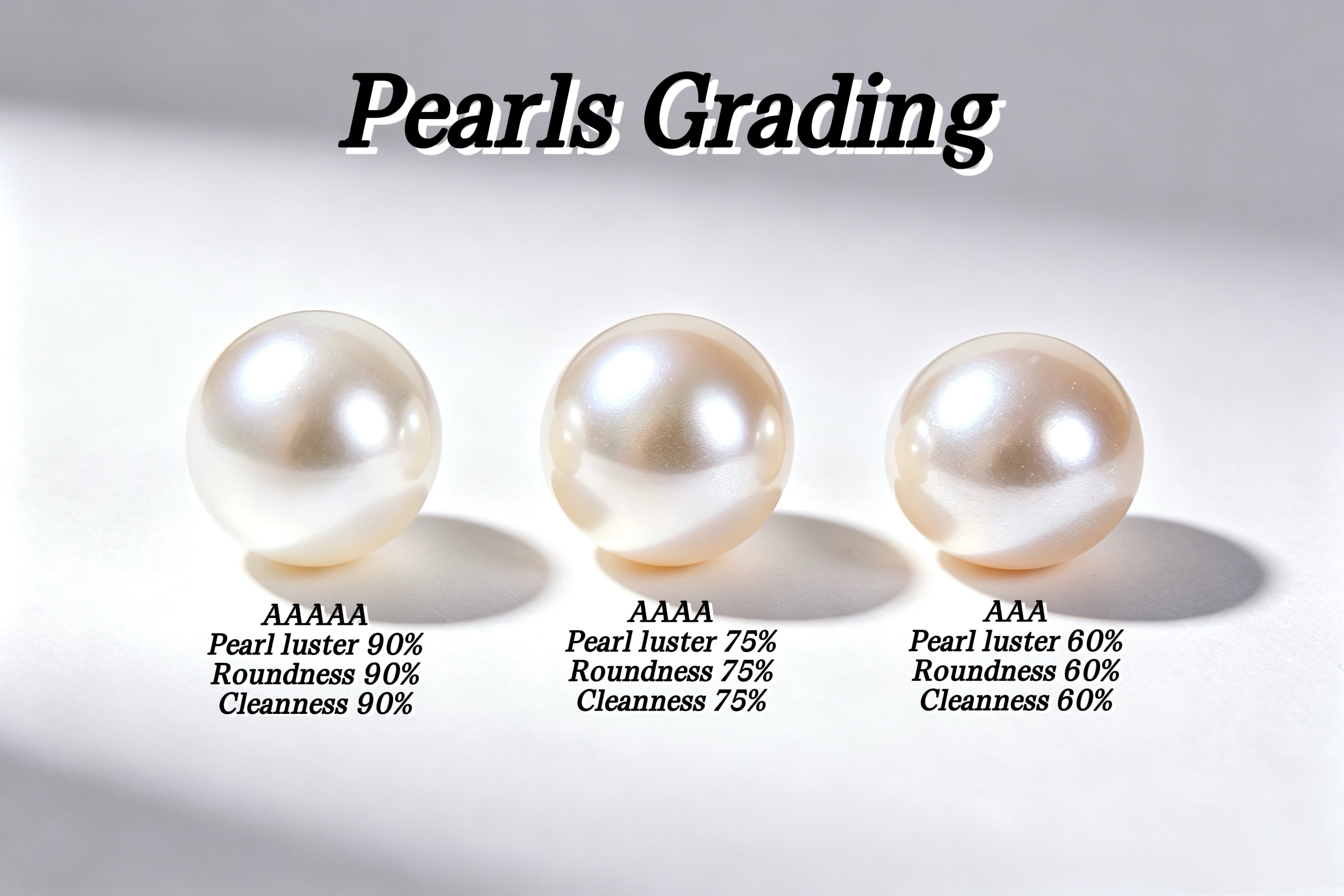
AAAAA is our top grade and the label is not decoration. Our grading chart scores a pearl on three things — luster, roundness and cleanness — and AAAAA sits at roughly 90% on all three, against about 75% at AAAA and 60% at AAA. The gap is felt mostly in the luster: at this level the reflection stays sharp even in soft indoor light, which is what separates a real pearl necklace from a strand that goes flat under shop lighting.
Luster is the part buyers under-check. Diameter and shape can be measured with a caliper, but luster only shows when a group of pearls is turned together under the same light. Set a handful on a white tray, tilt it towards a window and watch how far the highlight travels across each pearl — a dainty pearl necklace loses its brightness quickly if even a few pearls down the front are duller than the rest.
Clean means no blemishes visible at normal viewing distance: no spots, pits or chalky patches on the face of the pearl. Under a loupe you will still find the fine detail that comes with any cultured pearl, and that is normal — what matters at this grade is that nothing interrupts the surface when the piece is worn.
Perfectly-round is a measured shape, not an impression. The pearl rolls true on a flat surface and sits square in a setting with no high side, which counts most for studs and pendants where a single pearl carries the whole design. White at this grade runs creamy rather than blue-white, with a faint pink and green iridescence moving across the surface as the pearl turns.
Size & Strand Length
- 6.5~7 mm is a range, not a fixed number. Each pearl measures somewhere between those two points; that is normal for cultured pearls and the reason matched pairs are sorted with a caliper rather than by eye.
- The size behind a small pearl necklace that still reads. Large enough to be seen at conversation distance, small enough to wear with a shirt collar or under a fine chain.
- The most requested diameter for a pearl necklace for women. It sits at the collarbone without pulling the eye, and it is a safe first strand for a retailer testing a new line.
- What one millimetre changes. Moving up to 7.5–8 mm adds noticeable weight per pearl and a heavier look on the neck; decide on the finished piece you want, not on the number alone.
- A loose strand runs about 39.5 cm. That is the working length of the pearls themselves, before any clasp, extender or knotting goes on.
- Finished length is decided by the fittings. A clasp, a jump ring or a knotted finish each take up a few millimetres, so confirm the finished length you are selling rather than assuming the strand length carries over.
- Plan the count against the length. At this diameter you are working at roughly 1.5 pearls per centimetre, which is the figure to use when a customer asks for a specific finished length.
Weight & Pearl Yield
One lot weighs 3.27 kg and the average pearl comes in at about 0.42 g, which works out to roughly 7,700–7,800 pearls. Plan a production run around that count rather than the kilo figure alone: the weight tells you how much material you are buying, the count tells you how many pieces you can make. For a freshwater pearl necklace programme, divide your target material cost by that pearl count and you have a per-strand budget before you quote.
The same figures scale down cleanly. 100 pearls come to about 42 g and 500 to about 210 g. A single dainty pearl necklace in this size takes roughly 23–25 g of pearls, so allow 25–30 g once you have set aside the ones that will not pair — that allowance belongs in the cost of the piece, not in the fault column.
Weight and count drift slightly between lots, and that is expected: two lots of the same 6.5–7 mm grade will not weigh identically because each pearl grows to its own size inside the range. Quote a genuine pearl necklace programme against weight per thousand pearls, then reconcile the count on arrival — the container label carries size, grade, quantity and weight, so both figures can be checked before the pearls go into production.
Matching Pairs & Sorting
- Work on a white tray in daylight. A white surface shows true colour and luster; wooden benches and warm shop lighting shift both, and you will grade differently under each.
- Sort by diameter first. Group the pearls with a caliper in 0.2 mm steps inside the 6.5–7 mm range, because half a millimetre is visible when two pearls sit next to each other on a strand.
- Split each group by luster. Take every diameter group and divide it again by how far the highlight travels across the surface, so a white pearl necklace does not end up with bright and dull pearls alternating down the front.
- Check the surface last. Turn each pearl under the light and pull anything with a spot or chalky patch, even when it measures correctly — the grade is Clean, and a real pearl necklace is judged by the eye long before anyone reaches for a caliper.
- Build pairs face to face. Place two pearls with their strongest faces towards each other and check diameter, luster and colour together; a pearl necklace set with uneven studs is the fastest way to lose a repeat customer.
- Record the grouping. Note the diameter bands and how many pearls landed in each, so the next lot can be sorted the same way and your strands stay consistent between production runs.
Finished Pieces & Pairings
Studs, pendants and single-pearl rings are the most direct use: one 6.5–7 mm pearl is large enough to hold a setting and small enough to sit flat against the ear. A small pearl necklace built from this size also layers well — the pearls are light enough that three strands still feel comfortable by the end of an evening.
Bridal and occasion work takes this diameter easily. A dainty pearl necklace in 6.5–7 mm sits high on the collarbone with a wedding dress, and the same pearls work back into a bracelet or a pair of drops for the same client, which keeps a commission in one material. For retailers, it is the size that holds a mid-range price without looking like a novelty strand.
Plain retail strands remain the biggest use. A pearl necklace for women at this diameter is comfortable across a full day and photographs cleanly, because the roundness keeps highlights consistent from pearl to pearl — useful for lookbooks and live selling. When a customer wants more presence, move up to the 9.5–11.5 mm pearl necklace; when they want a set, the 12–13 mm pearl earrings sit alongside this size in the same white family.
Ordering & Delivery
- Minimum order value: USD 500 per order.
- Dispatch and delivery: orders are dispatched within 3–5 business days and delivery typically takes 5–7 days. Customs clearance in your country can extend that, so check local processing times if you are working to a launch date.
- Carriers and origin: FedEx, DHL and SF Express, with every order shipped from Hong Kong.
- Custom orders: send a reference design or a description of the piece you have in mind. Our team sources suitable materials, produces to it, and confirms the details with you at each stage before the work is finished. Custom pieces may need additional processing time, so ask for the schedule before you commit.
- Design briefs: tell us the finished length and the look you are after — a pearl necklace for women at 42 cm and one at 50 cm take very different pearl counts, and we would rather cost the right one.
- Sets and pairs: building a pearl necklace set with matching earrings? Send the reference and we will confirm what this size can match before anything is made up.
- Payment: telegraphic transfer (T/T), Alipay, WeChat Pay, Mastercard and Visa.
- Larger quantities: preferential pricing is available for larger orders — ask our team for a quotation with your quantity and size mix.
- Cancellation: an order can be cancelled within 24 hours of being placed. Contact us as soon as possible if something needs to change.
- Returns: all sales are final and we do not accept returns or exchanges. Every order is confirmed several times before dispatch, with detailed photos and video for your review and a final confirmation before packing, so what leaves Hong Kong is what you approved.
- Taxes and duties: prices are shown in USD and exclude customs duties and taxes. Any import charges are the customer's responsibility.
- Fittings: the listed price covers the pearls only. Clasps, posts, settings and other accessories are not included.
- Buying remotely: if you buy pearl necklace online, ask for a live video look at the lot — a short call shows luster and colour more clearly than any still photograph.
Scale & Supply Capability
KT JEWELLERY has been based in Hong Kong since 2006, with a team of 106 looking after selection, quality control and dispatch under one roof. Our in-stock selection runs across sizes, colours and grades, so most orders leave without a long wait. Custom work is welcome: share a reference design or an idea and we source suitable materials, make to it, and confirm every detail with you — photos included — before dispatch. Every piece passes through our own quality control, and we are a regular presence at the Hong Kong Jewellery Show.
FAQ
Q1. Is 39 cm the maximum length of the pearl strand?
Our loose strands run to about 39.5 cm of pearls. That is the pearl length before any finishing: a clasp, a jump ring or a knotted end each take up a few millimetres, so a finished white pearl necklace will not match the strand length exactly. Tell us the finished length you need and we will confirm what the pearls can do.
Q2. How many pearls does a finished strand take?
At 6.5–7 mm a 39.5 cm strand takes roughly 55–60 pearls once the ends are finished. A small pearl necklace for a choker needs fewer, and a longer length proportionally more — work on about 1.5 pearls per centimetre when you are quoting a finished piece.
Q3. Are the pearls drilled or ready to set?
They are supplied as loose round pearls, so no holes, posts or fittings are part of this lot. If your genuine pearl necklace design needs half-drilled pearls, tell us before ordering and we will confirm what can be prepared in this size and how long it takes.
Q4. How can I keep my pearl bracelet shining?
Wipe the pearls with a soft, slightly damp cloth after each wear and let them dry fully before they go back into their pouch. Keep them away from perfume, hairspray, sunscreen and chlorinated water, and store them separately from metal pieces that can scratch the surface. Restring a bracelet or freshwater pearl necklace once the thread starts to stretch, so the pearls stop rubbing against each other at the drill holes.
Q5. Are the pearls dyed, and how white are they?
This lot is graded white — a creamy white with a faint pink and green iridescence rather than a flat, chalky tone. No dyed colour is listed for it. If the pearls have to sit next to a real pearl necklace you already own, ask for daylight photographs of the current lot before you commit; white can be matched closely, but never perfectly across two production runs.